> ## Documentation Index
> Fetch the complete documentation index at: https://docs.msportal.ai/llms.txt
> Use this file to discover all available pages before exploring further.
# Track installed software
> Find end-of-life and out-of-date software across your clients from Devices > Software.
The **Software** tab under **Devices** lists the software installed on your clients' devices. It groups each product across devices and flags installs that have reached end of life, reach it soon, or are behind the latest update.
Branch preview for the Devices software update. For MSP staff with access to Devices. Company users do not see the Software tab. The tab appears when the Software inventory feature is turned on for your portal.
## Before you start
* Connect **ConnectWise Asio** or **Datto RMM** and import devices. Software is collected only for imported devices.
* Choose **Software** in the integration's dedicated **Sync** step. New connections sync software after devices are imported. Ongoing inventory syncs run daily: **ConnectWise Asio at 04:00 UTC** and **Datto RMM at 04:30 UTC**. See [Sync schedules](/user-guides/integrations/sync-schedules).
* See [Choose what the integration syncs](#choose-what-the-integration-syncs) to enable or disable inventory collection.
## Review software across your clients
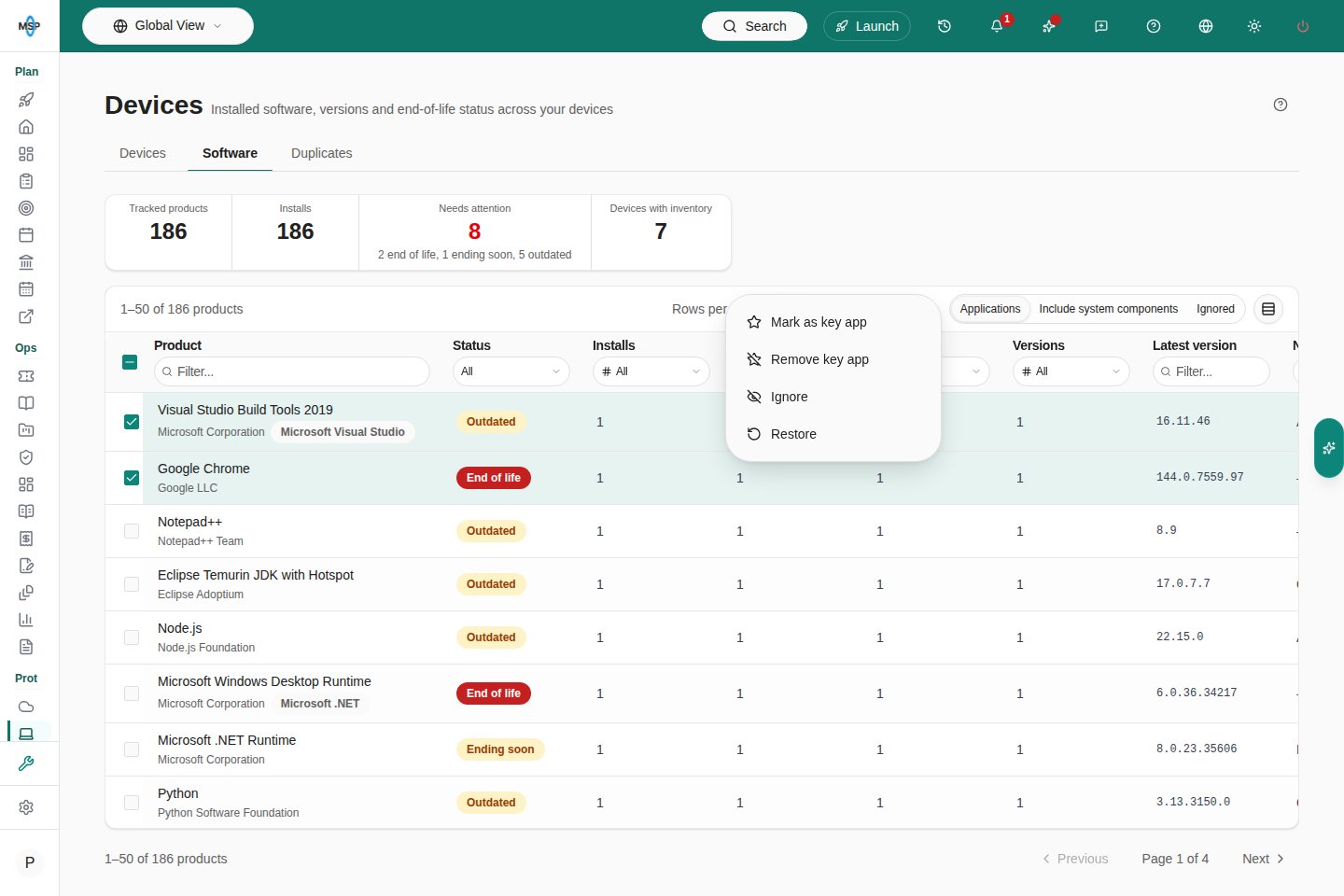
Select **Devices > Software**. The company selector applies, so choose the companies you want to review.
The summary shows **Tracked products**, **Installs**, **Needs attention**, and **Devices with inventory**. **Needs attention** breaks down into end of life, ending soon, and outdated installs.
Select **Needs attention** in the summary, or choose **Needs attention** in the **Status** filter. Use the **Product** filter to search by name or publisher. Every data column supports sorting and filtering: numeric columns accept ranges and **Next end of life** accepts a date range. Filters apply to the full matching inventory, including rows on later pages.
**Applications** is the default view. **Include system components** adds runtimes and vendor utilities that have no lifecycle data, such as Visual C++ redistributables. **Ignored** lists products you have ignored.
 ## What each status means
| Status | Meaning |
| - | - |
| **End of life** | The release is end of life. Releases with a published end-of-life date are flagged after a 30-day grace period. |
| **Ending soon** | The installed release reaches end of life within 90 days. Shown for releases with long support periods, such as Microsoft Office, .NET, Java and SQL Server. |
| **Outdated** | The install is below the target version you set, or below the latest update published for its release. |
| **Current** | No lifecycle or version rule marks this install as needing attention. |
| **Unknown** | The RMM reported no usable version for this install. |
End-of-life dates and latest versions come from [endoflife.date](https://endoflife.date), refreshed daily. Products with a reported version but no lifecycle data are **Current** unless you set a target version. **Current** means no known issue was found; it does not establish that the vendor supports the installed release.
## Investigate a product
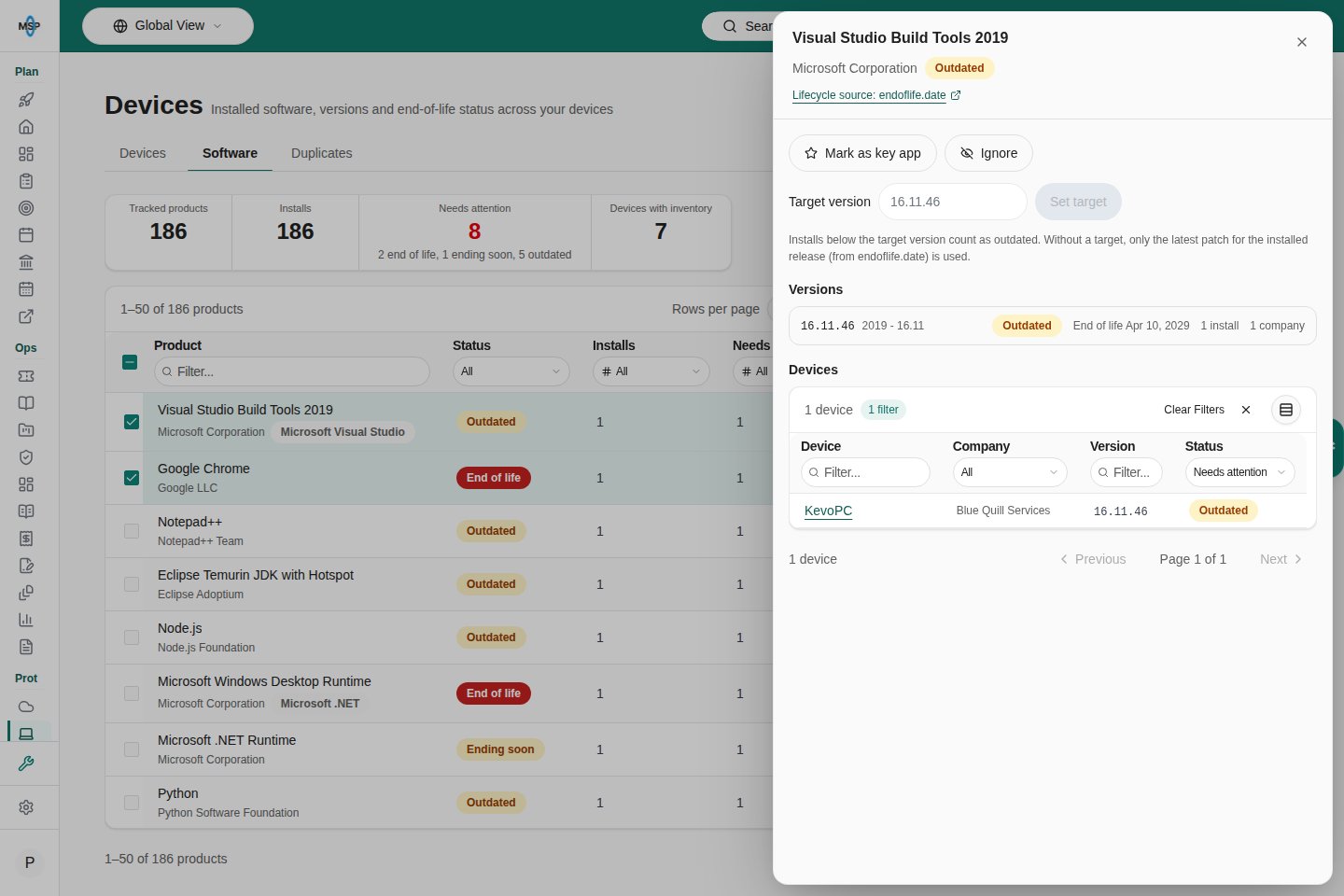
Select a product to open its details. The sheet shows the lifecycle source, each installed version with its status and end-of-life date, and the devices that have the product.
* Select a version to list only the devices running it. Select it again to clear the filter.
* The **Status** filter defaults to **Needs attention only**. Clear it to see every device with the product.
* The compact device table supports sorting and filtering by device, company, version, and status. It displays 25 rows per page.
* Select a device to open its details.
## What each status means
| Status | Meaning |
| - | - |
| **End of life** | The release is end of life. Releases with a published end-of-life date are flagged after a 30-day grace period. |
| **Ending soon** | The installed release reaches end of life within 90 days. Shown for releases with long support periods, such as Microsoft Office, .NET, Java and SQL Server. |
| **Outdated** | The install is below the target version you set, or below the latest update published for its release. |
| **Current** | No lifecycle or version rule marks this install as needing attention. |
| **Unknown** | The RMM reported no usable version for this install. |
End-of-life dates and latest versions come from [endoflife.date](https://endoflife.date), refreshed daily. Products with a reported version but no lifecycle data are **Current** unless you set a target version. **Current** means no known issue was found; it does not establish that the vendor supports the installed release.
## Investigate a product
Select a product to open its details. The sheet shows the lifecycle source, each installed version with its status and end-of-life date, and the devices that have the product.
* Select a version to list only the devices running it. Select it again to clear the filter.
* The **Status** filter defaults to **Needs attention only**. Clear it to see every device with the product.
* The compact device table supports sorting and filtering by device, company, version, and status. It displays 25 rows per page.
* Select a device to open its details.
 ### Update several products
1. Select the intended products using their checkboxes. Selection applies to the current page, with up to 200 products per page.
2. Open **Actions (selected count)** and choose **Mark as key app**, **Remove key app**, **Ignore**, or **Restore**.
3. Review the result. Ignored products move to **Ignored**, where you can select and restore them. Changing company scope, filters, sorting, or pages clears selection.
Bulk actions require permission to edit devices. They change the portal's software classification; they do not uninstall applications or change installed versions.
### Mark key apps, ignore products, and set a target version
MSP staff who can edit devices can change these settings in the product sheet. Each change saves immediately.
| Action | Effect | Reverse |
| - | - | - |
| **Mark as key app** | Adds a star to the product and includes it in the **Key apps** status filter. | **Remove key app** |
| **Ignore** | Hides the product from the default and system component views and from the summary counts. | Open the **Ignored** view, select the product, then **Restore** |
| **Set target** | Counts installs below the version you enter as **Outdated**. Enter a version number such as 124.0.2. | **Clear target** |
## Check one device's software
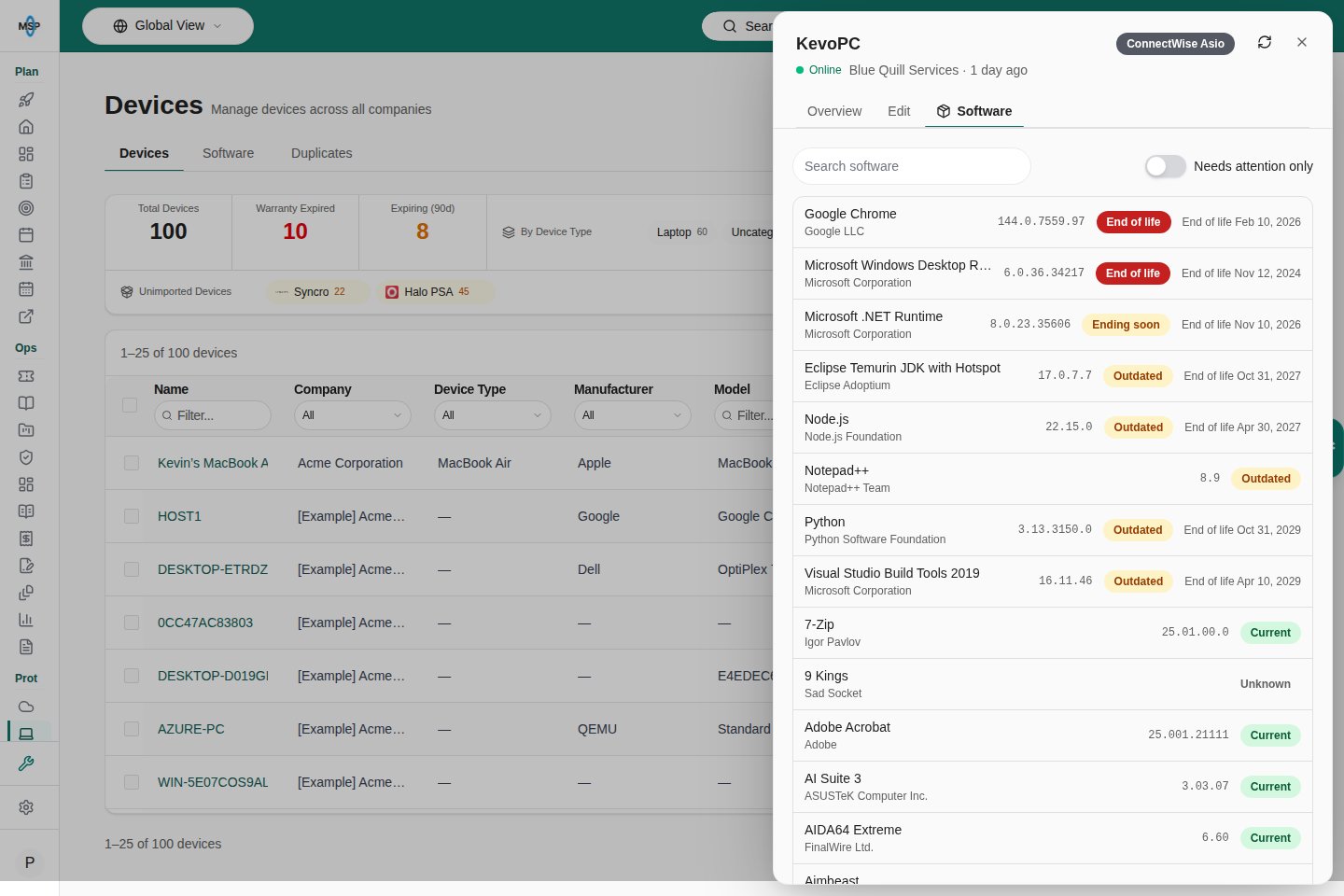
Open a device from **Devices** and select its **Software** tab. The list shows each product with its version, status and end-of-life date, worst status first. Use **Search software** or turn on **Needs attention only** to narrow the list.
### Update several products
1. Select the intended products using their checkboxes. Selection applies to the current page, with up to 200 products per page.
2. Open **Actions (selected count)** and choose **Mark as key app**, **Remove key app**, **Ignore**, or **Restore**.
3. Review the result. Ignored products move to **Ignored**, where you can select and restore them. Changing company scope, filters, sorting, or pages clears selection.
Bulk actions require permission to edit devices. They change the portal's software classification; they do not uninstall applications or change installed versions.
### Mark key apps, ignore products, and set a target version
MSP staff who can edit devices can change these settings in the product sheet. Each change saves immediately.
| Action | Effect | Reverse |
| - | - | - |
| **Mark as key app** | Adds a star to the product and includes it in the **Key apps** status filter. | **Remove key app** |
| **Ignore** | Hides the product from the default and system component views and from the summary counts. | Open the **Ignored** view, select the product, then **Restore** |
| **Set target** | Counts installs below the version you enter as **Outdated**. Enter a version number such as 124.0.2. | **Clear target** |
## Check one device's software
Open a device from **Devices** and select its **Software** tab. The list shows each product with its version, status and end-of-life date, worst status first. Use **Search software** or turn on **Needs attention only** to narrow the list.
 ## Retrieve software information through MCP
Connect an AI client to the [MSPortal MCP server](/user-guides/mcp-server/index) and ask for installed products, key applications, outdated or end-of-life installs, product version details, or the devices running a particular product. The server reads the same staged inventory within your staff permissions and selected company scope.
The grouped **query\_software** tool exposes four read actions: **get\_software\_inventory\_overview**, **list\_software\_products**, **get\_software\_product**, and **list\_software\_product\_devices**. Use the schemas returned by your connected server; product and device lists are paginated. Product details return up to 200 version groups and signal truncation when that cap is reached. These actions do not install, update, uninstall, or reclassify software. Use the Software workspace to change key-app, ignore, or target-version settings.
## Choose what the integration syncs
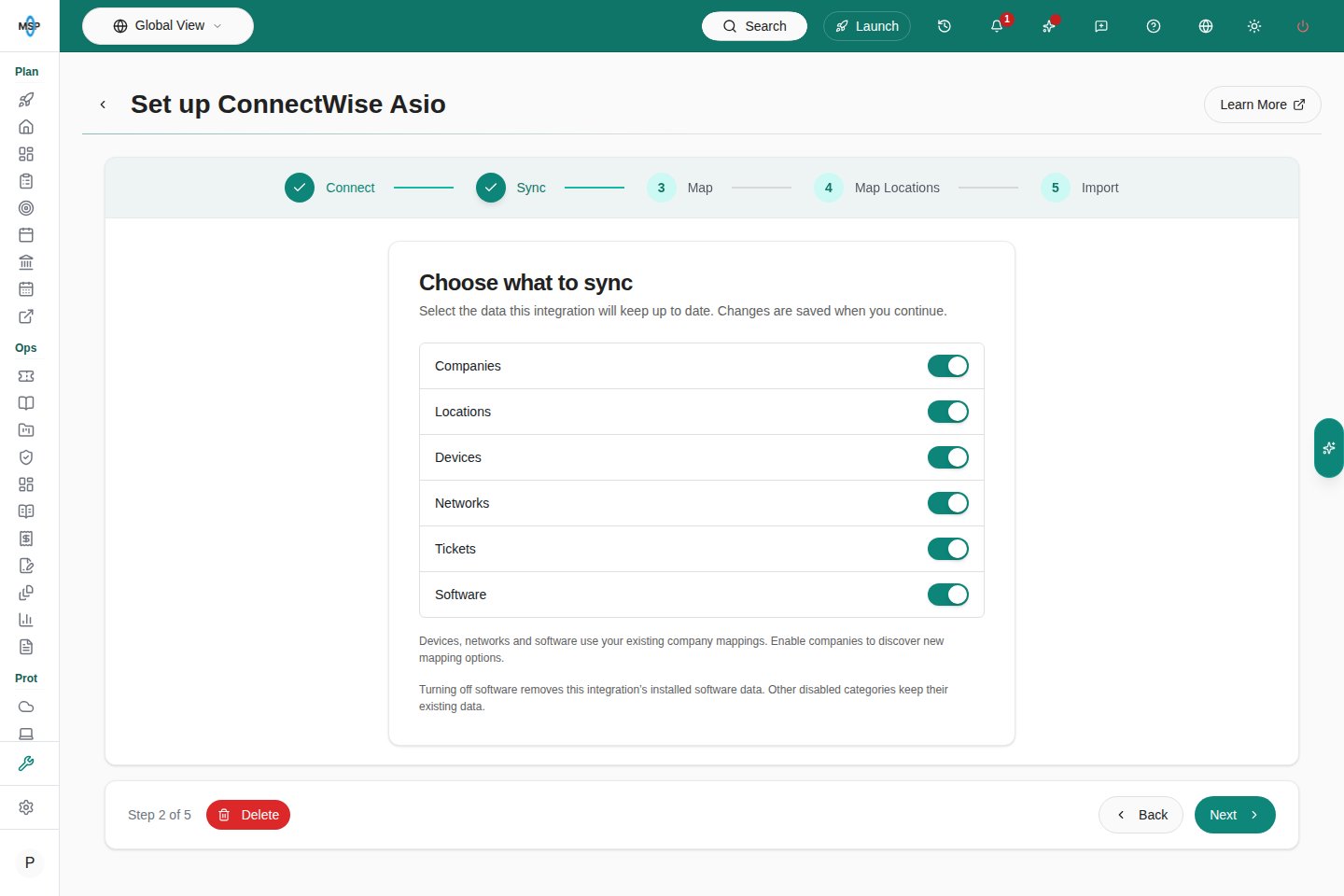
Go to **Settings > Integrations**, open your ConnectWise Asio or Datto RMM integration, and continue to the **Sync** step.
Asio offers **Companies**, **Locations**, **Devices**, **Networks**, **Tickets**, and **Software**. Datto RMM offers **Companies (Datto sites)**, **Devices**, and **Software**.
Select **Next** to save the choices and continue to company mapping and imports. Existing connections retain their current behavior until you save different choices.
Turning **Software** off removes that integration's software inventory from MSPortal. Turning it on starts collection for imported devices; new connections collect software after their device import finishes. Disabling other categories stops their future synchronization.
Read [Asio setup](/user-guides/integrations/enable-connectwise-asio-integration) or [Datto RMM setup](/user-guides/integrations/enable-datto-rmm-integration) for credentials, mapping, and import details.
## Retrieve software information through MCP
Connect an AI client to the [MSPortal MCP server](/user-guides/mcp-server/index) and ask for installed products, key applications, outdated or end-of-life installs, product version details, or the devices running a particular product. The server reads the same staged inventory within your staff permissions and selected company scope.
The grouped **query\_software** tool exposes four read actions: **get\_software\_inventory\_overview**, **list\_software\_products**, **get\_software\_product**, and **list\_software\_product\_devices**. Use the schemas returned by your connected server; product and device lists are paginated. Product details return up to 200 version groups and signal truncation when that cap is reached. These actions do not install, update, uninstall, or reclassify software. Use the Software workspace to change key-app, ignore, or target-version settings.
## Choose what the integration syncs
Go to **Settings > Integrations**, open your ConnectWise Asio or Datto RMM integration, and continue to the **Sync** step.
Asio offers **Companies**, **Locations**, **Devices**, **Networks**, **Tickets**, and **Software**. Datto RMM offers **Companies (Datto sites)**, **Devices**, and **Software**.
Select **Next** to save the choices and continue to company mapping and imports. Existing connections retain their current behavior until you save different choices.
Turning **Software** off removes that integration's software inventory from MSPortal. Turning it on starts collection for imported devices; new connections collect software after their device import finishes. Disabling other categories stops their future synchronization.
Read [Asio setup](/user-guides/integrations/enable-connectwise-asio-integration) or [Datto RMM setup](/user-guides/integrations/enable-datto-rmm-integration) for credentials, mapping, and import details.
 ## Troubleshooting
| Situation | What to check |
| - | - |
| No **Software** tab | The Software inventory feature is not turned on for your portal, or you are signed in as a company user. |
| The tab shows no products | Whether ConnectWise Asio or Datto RMM is connected, devices are imported, and an inventory sync has finished. |
| A device has no software | Whether it is imported from a supported RMM and whether **Software** is selected and saved in that integration's **Sync** step. |
| A product shows **Unknown** | The RMM reported no usable version for that install. |
| An auto-updating app shows **Outdated** | A target version is set above the installed version. Clear or change the target. |
## Frequently asked questions
Browsers and other auto-updating apps move through versions quickly. They are flagged when their release passes end of life by more than 30 days, or when they fall below a target version you set.
No. Ignoring only hides the product in MSPortal. Nothing changes on the device or in the RMM.
No. The Software tab is available to MSP staff only.
Return to the Devices overview.
Read the other tabs in a device's details.
This documentation is built and hosted on [Mintlify](https://mintlify.com), a developer documentation platform.
## Troubleshooting
| Situation | What to check |
| - | - |
| No **Software** tab | The Software inventory feature is not turned on for your portal, or you are signed in as a company user. |
| The tab shows no products | Whether ConnectWise Asio or Datto RMM is connected, devices are imported, and an inventory sync has finished. |
| A device has no software | Whether it is imported from a supported RMM and whether **Software** is selected and saved in that integration's **Sync** step. |
| A product shows **Unknown** | The RMM reported no usable version for that install. |
| An auto-updating app shows **Outdated** | A target version is set above the installed version. Clear or change the target. |
## Frequently asked questions
Browsers and other auto-updating apps move through versions quickly. They are flagged when their release passes end of life by more than 30 days, or when they fall below a target version you set.
No. Ignoring only hides the product in MSPortal. Nothing changes on the device or in the RMM.
No. The Software tab is available to MSP staff only.
Return to the Devices overview.
Read the other tabs in a device's details.
This documentation is built and hosted on [Mintlify](https://mintlify.com), a developer documentation platform.