

Sign in and choose your scope
Use the portal URL and sign-in method your administrator supplies. Complete the invitation or account setup instructions when required; available password, Microsoft and Google sign-in methods depend on the organization’s configuration. Use the company selector to choose the client or portfolio view you intend to work with. Then inspect the page, selected record and any scope selector inside the editor. Some settings apply to the entire organization; other pages and dialogs have their own company or connection choice. Changing the top-bar company is not proof that every subsequent action is company-specific.Find your way around
- Sidebar: open the module you need. Its contents depend on permissions, enabled features, connected providers and navigation preferences.
- Search: use the top-bar search control or Ctrl+K / Cmd+K, then choose a result you can access.
- Settings: open administration and personal preferences. Check whether you are changing your account, a company or the organization.
- Help: use the current page’s Help entry where available to find its workflow guide.
Prepare your first rollout
- Open Launch Center and choose the setup goals and rollout companies that match your plan.
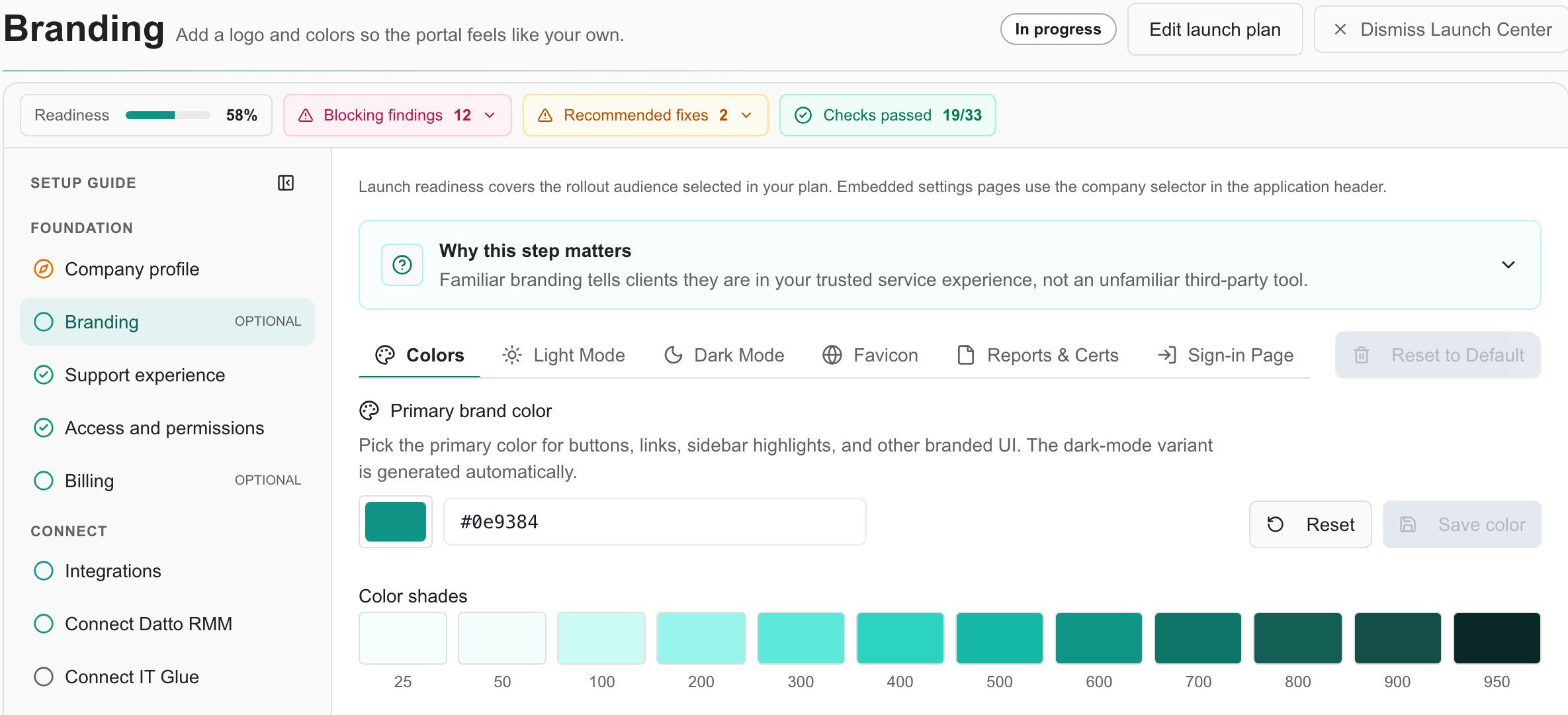
- Review organization details, access and branding in the MSP Setup Playbook.
- Connect the intended provider instances, review imported records and save company mappings. A successful connection test is separate from saving and synchronization.
- Select a pilot company and inspect the records that actually loaded. Resolve missing mappings or stale sync results before inviting the wider audience.
- Review client permissions, visibility and the selected rollout companies’ readiness. A completed setup task is not proof that every client can access the intended feature.
Save deliberately
Follow the current form’s Save or apply action. Some actions save immediately, including certain row changes, uploads and creation controls. Reset, Cancel, and closing an editor do not have identical meanings everywhere. Read the task guide before assuming an already saved action will be undone. Keyboard shortcuts are screen-specific. See Keyboard shortcuts for supported controls rather than assuming Ctrl+S or Ctrl+Enter saves every form.Start a client workflow
Use Surveys and Goals to capture priorities, Planner to organize work, Budgets to review planned spend, and Calendar or Reports to prepare the client discussion. Open the relevant module guide before importing, applying templates or using provider actions; those operations have different save boundaries.Frequently asked questions
Where is the onboarding wizard?
Where is the onboarding wizard?
Use Launch Center and the MSP Setup Playbook. The current setup experience follows your selected goals and rollout audience; do not wait for the old floating first-sign-in helper.
Why can a colleague see a module I cannot?
Why can a colleague see a module I cannot?
Compare role permissions, enabled features, provider availability and sidebar preferences. An active provider connection alone does not grant access.
Does choosing a company scope every setting to that company?
Does choosing a company scope every setting to that company?
No. Check the page or dialog’s own scope. Organization settings, personal preferences and individual integration instances can have separate scope.
Does setup completion prove clients can use the portal?
Does setup completion prove clients can use the portal?
No. Check readiness, saved mappings and the intended Company user’s role and access before expanding the rollout.