

Branch preview for the September 18 release. These controls are not yet published. Screenshots show MSPortal Demo running the release branch.
Set a company’s device platform
Open MSP Tools > Standards, expand Company device platform, and choose the company. Select Only PCs, Only Macs, or PCs and Macs, then select Save. Standards can then test the platform with a Device platform condition.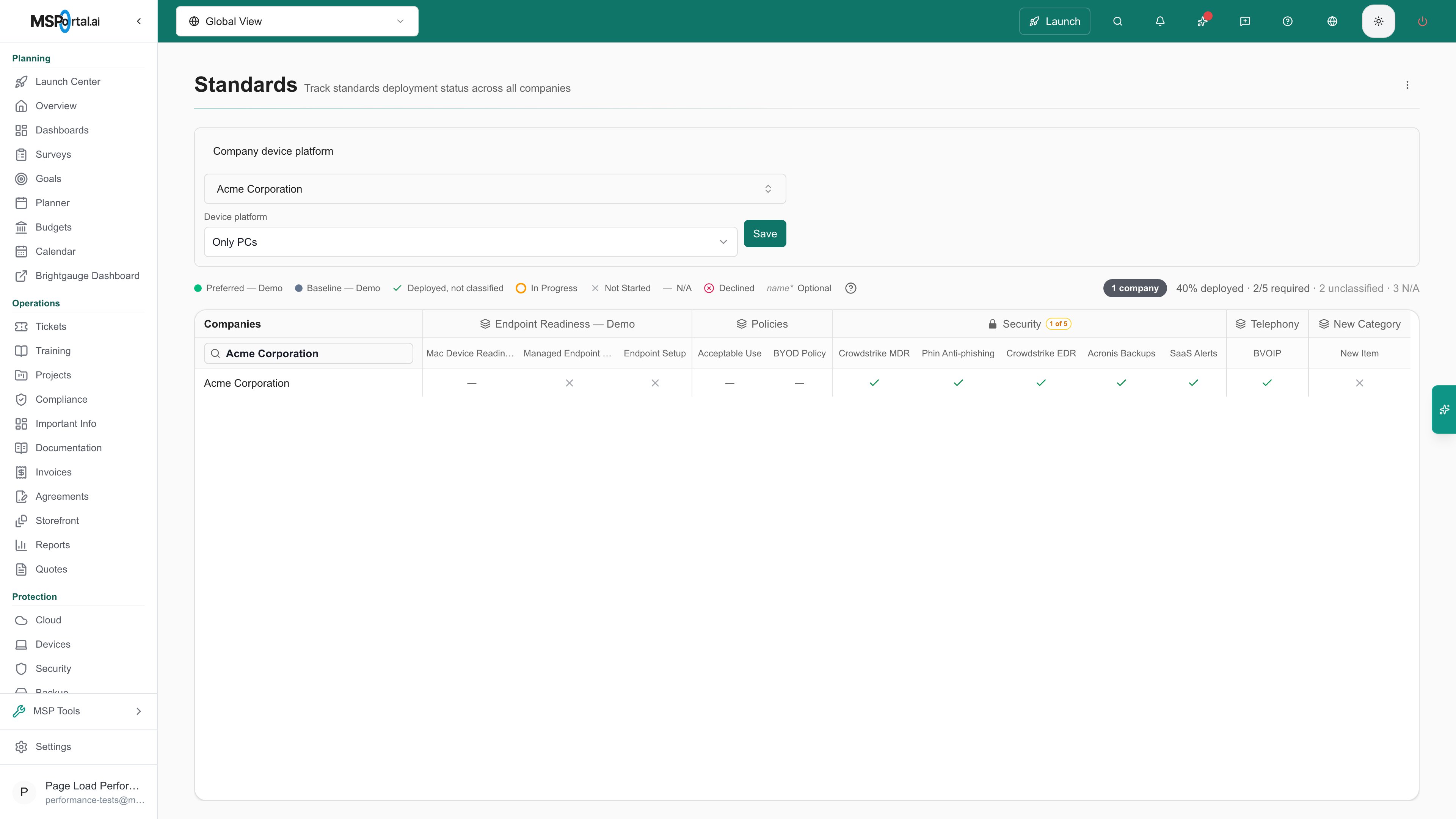
Choose the company and its device platform.
Add conditions to a standard
1
Open the standard
Open Settings > MSP Tools > Standards, expand the category, and select the
standard’s name to open its editor. Find Applies to.
2
Add a condition
Select Add condition. Choose what to test, a comparison such as is any of,
and the values. A new standard applies to every company until you add one.
3
Combine conditions
With two or more conditions, choose whether the standard applies when
all conditions match or when any condition matches.
4
Save and check the matrix
Select Save, then return to Standards. Companies that don’t match show the
standard as a locked N/A.
Standards that used a device platform or one company field before this release
keep the same result. Their rules appear as conditions in Applies to.
Rule-driven N/A cells cannot be edited and do not count as compliance gaps.
Their previous deployment answers are retained. If a later rule change makes a
standard applicable again, its saved answer becomes visible again.
Missing values
A company with no value for a condition keeps the standard, so incomplete records cannot silently improve its compliance percentage. To target companies with no value, use is empty or is not empty. For example, Industry is not empty excludes companies whose industry was never set. Compliance checks use the same conditions, plus device conditions. See Compliance Settings.Understand scoring and service plans
Condition exclusions remove inapplicable checks from the Standards compliance calculation and the corresponding Client Health scoring. Client Health can reflect an earlier scoring run; compare scope and refresh time. Service-plan membership is a separate setting in each standard’s editor. An empty plan selection means all plans. A standard outside a company’s target plan is de-emphasized with an explanatory dot, but plan membership currently does not reduce the compliance denominator.Troubleshooting
Manage the Standards catalog
Create and organize the standards used by these rules.
Read the Standards matrix
Interpret recorded deployments, exclusions, and required checks.